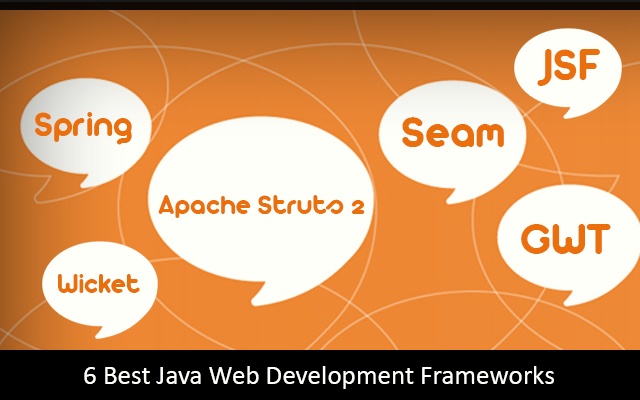
6 Best Java Web Development Frameworks

Java application supportMost developers use Java frameworks to build engaging and interactive web application without putting any extra time and effort. Also, each developer has options to choose from a variety of Java web application development frameworks to suit the specific requirements of his project. Similar to other advanced web development frameworks, most Java development frameworks now support the Model-View-Controller (MVC) design. The design makes it easier for developers to separate business logic and presentation.

Further, the flow of client requests and server actions are coordinated in a logical way through a controller. Each Java web development framework is designed with distinct features and functionality. Similarly, the Java bean wrappers, Java Server Pages and tag libraries will also differ based on your choice of framework. But a developer can still use a set of similar APIs to easily design and implement powerful web applications. If you are new to Java development, it is a good idea to check out some of these popular web development frameworks.

6 Widely Used Java Web Development Frameworks

  • Apache Struts 2: As an enterprise-ready web application development framework, Apache Struts allows developers to streamline the entire development project cycle. Struts 2 also come with an improved design with clean code for frameworks that do not depend on HTTP and create dynamic responses. A developer can use the AJAX tags to add flexibility and interactivity to the web pages by availing the advantages of standard Struts tags. He can also use Struts 2 as an open source tool to build small projects. However, the framework does not allow programmers to develop apps simply by dragging and dropping controls.

  • Spring: Spring is hugely popular as a powerful yet flexible development framework. You can use Spring to boost the look, feel and performance of your web application without writing lengthy codes. The framework allows you to integrate a wide variety of view options including PDF, Excel, Velocity and JSP/JSTL, seamlessly based on the requirements of your application. At the same time, you can also use the Inversion of Control provided by Spring to easily test your web application. The support of a large developer community also makes the framework popular for developing a variety of enterprise internet applications.

  • Wicket: In comparison to conventional Java development frameworks, Wicket is more straightforward, and also goes in the opposite direction. Without using XML, Wicket separates logic and markup, along with using a POJO data model. You can insert HTML-based templates to make the web pages dynamic, while keeping Java away from your page design. Along with offering the advantages of pure Java, the framework is also more object-oriented in comparison to others. However, a developer or designer must possess adequate experience to use Wicket in an exact and accurate way.

  • Seam: Unlike other Java development frameworks, Seam is effective in bundling Java EE standards as well as making them work together as a integrated solution. Along with core standards like EJB3 and JSF, Seam also ties other components together to facilitate smooth work flow and rule management. The integration of core standards and components has made it easier for Seam to avoid the complexity at the architecture and API level. Seam also allows enterprise application developers to avail a number of advantages like built-in libraries for PDF, graphs, Excel, and email. The reduce amount of XML will add stability to your application, whereas the built-in libraries will save your time and effort.

  • Java Server Faces (JSF): In comparison to the modern Java development frameworks, JSF is a bit older. But JSF is still popular among developers due to supporting Java EE standard. The feature makes it easier for developers to build using interfaces using components on a page. Also, the components can be used or added to make it easier for you to capture the events triggered by their actions. JSF also allows developers to avail build powerful interfaces by availing the advantaged of MVC model. Further, its stable and easy to use features can complement the needs of a variety of enterprise web applications.

  • Google Web Toolkit (GWT): The huge popularity of Google often makes developers to write AJAX applications like Gmail and Google Maps. The Google Web Toolkit makes it easier for developers to build and maintain complex front-end interfaces designed using JavaScript and Java. They can further develop and debug AJAX apps using any Java development tool of their choice. However, the use of JavaScript will require programmers to put some extra efforts to share, test and reuse the AJAX components. But some of the features provided by the framework will make it easier for them to handle bookmarking, asynchronous remote procedure calls, history management and cross-browser portability.

The choice of Java web development framework varies from one developer to another. It is always important to pick a framework by keeping in mind the specific need of your project. Also, you have to evaluate the pros and cons of individual frameworks to choose the option that saves your time and effort.

We provide Java application development services. If you would like to discuss with an expert Java developer from our team, please get in touch with us at Mindfire Solutions.

Is Java still the fastest growing technology in 2013?

Java web services developmentNobody can deny the huge popularity of Java as a powerful technology to build applications to target different web browsers, operating systems and devices. But the popularity of the technology was recently affected due to certain bugs that were misused by malicious people to carry out identity thefts and other crimes. Despite Oracle releasing a security update of Java software for web browsers, software developers and researchers are still skeptical about its effectiveness in providing adequate protection to computers from these attack.

The U.S. Department of Homeland Security has already warned users not to run Java in their web browsers, unless it is absolutely necessary. According to Reuters.com,The U.S. Department of Homeland Security warned that a security update of Oracle Corp’s Java software for Web browsers does not do enough to protect computers from attack, sticking to its previous advice that the program be disabled.” The report further added, “Security experts have warned that PCs running Java in their browsers could be attacked by criminals seeking to steal credit-card numbers, banking credentials, passwords and commit other types of computer crimes.

However, many security experts have said that the bugs are affecting only one part of Java platform, i.e., the software that users plug into their web browser. So, developers can still use Java in 2013 to write one set of code that is compatible with computers running on a variety of operating systems including Apple Macs, Microsoft Windows, and Linux. Despite the experts criticizing the security update released by Oracle, many developers are still excited about a several Java trends. Some of these upcoming trends will further contribute towards Java’s popularity and growth in 2013.

Trends that will Contribute towards Java’s Growth in 2013

Java 8: Most developers are looking forward to the release of latest version of Java. Oracle is expected to release Java 8 in September, if everything goes as per schedule. The updated version will allow developers to start developing applications using the long awaited lambdas functions. However, many tech bloggers have started highlighting the complex nature of the new feature even before its release. The new feature along with the improved Date and Time API will encourage many developers to use Java 8 for making robust web applications.

Powerful Java Virtual Machine (JVM) Languages: Most developers use several JVM Languages to develop software that will run seamlessly on the Java Virtual Machine. As the JVM languages comprises of a number of computer programming language, a developer can easily pick his favorite language to write codes. In 2012, many companies invested in a variety of JVM languages. The trend will continue this year, and many companies will launch new versions to provide programmers with additional features and functionality.

New JavaScript Engine: The upcoming Java version will come with a new JavaScript engine. The engine will make it easier for developers to embed JavaScript into their Java applications. As JavaScript is still used in developing all types of websites, the embedded engine will encourage many developers to use the latest version of Java. The open source project was included last year as part of the OpenJDK repository. The feature becomes more exciting as it includes node.js which is widely used by developers, and adds polyglot future to the engine.

Improved Java API: The OpenJDK also includes a project that aims to use GPU to optimize the greater Java performance. The project is also tested using Java 8 library and specific languages like lambdas. With the advanced feature developers will be able to develop robust web applications using Java API and its constructs.

Java Cloud Functions: Similar to other large companies, Oracle has further established Java in the world of cloud computing. However, the Java cloud features are delayed till the release of Java EE 8. So the providers have to use individual standards. But the updated version will come with a universal framework like jClouds that will optimize and standardize Java’s own cloud features. The growing popularity of cloud computing will further boost the popularity of Java application development.

We provide Java development services. If you would like to know more about our certified Java developers, please get in touch with us at Mindfire Solutions.

10 Reasons to Learn Java Programming Language and Why Java is Best

java web application developmentToday Java is everywhere. It was developed by James Gosling by Sun Microsystems which is merged with Oracle Corporation now. It can be best defined as dynamic, secure, object-oriented, distributed, interpreted, robust, portable, high-performance, general-purpose programming language. This programming language has been the core part of Java platform which designs customized applications sufficing the needs of a variety of computing platforms from cell phones to personal computers.

Java is popular among software developers and users because of the light and compact applications it can produce in significantly less time. Card Java aims at smart cards and Embedded Java is designed for everything from networked air conditioning units to printers. The Java development kit is used for developing desktop computer applications and applets.

Here is a list of 10 reasons, why to learn Java and whether Java is the best programming language in terms of development, community support and opportunities.

Java is Easy to learn: Java has got an easy fluent english like syntax with minimum magic characters e.g. Generics angle brackets, which makes it easy to read Java program and learn quickly. Programmers can easily install JDK and set up the PATH and understand how Classpath works, then it will be pretty easy to write programs in Java.

Java is an Object Oriented Programming Language: Java is an Object Oriented Programming language. Developing OOPS application is much easier and it also helps to keep system modular, flexible and extensible. Oops concepts such as Abstraction, Encapsulation, Polymorphism and inheritance, which are used by Java, helps the programmers achieve tasks easily.

Java has Rich API: One more reason for Java programming language’s huge success is its Rich API and most importantly it’s highly visible, because it comes with Java installation. Java Applets provide great animation capability, which amazes new programmers like us, who are used to code in Turbo C++ editor. Java provides API for I/O, networking, utilities, xml parsing, database connection and almost everything.

Powerful development tools: Eclipse and Netbeans has played a huge role to make Java one of the best programming languages. It has a powerful debugging capability, which is essential for real world development. Integrated Development Environment (IDE) made Java development much easier, faster and fluent. With tools Java(IDE) can build some amazing applications meeting current business demands.

Great collection of Open Source libraries: With open source libraries, Java could be used everywhere. Apache, Google and other organizations have contributed a lot of great libraries, which make Java development easier, faster and cost effective. There are frameworks like Spring, Struts, Maven, which ensure that Java development follows the best practices of software development and promotes the use of best design patterns.

Wonderful community support: Community is the biggest strength of the Java programming language and platform. Java has been very lucky, it has lots of active forums such as Stack overflow, open source organizations and several Java user groups to help everything. There is a community to help beginners, advanced programmers and even experts.

Java is FREE: Everyone wants to set up their website for free. The organization wants to use a technology, where cost is a major factor. Since Java is free, one can create Java applications at no cost. This FREE thing also helped Java to become popular among individual programmers and among large organizations.

Excellent documentation support: Not everyone has time and intention to look at code to learn what a method does or how to use a class. Java documents make learning easy and provide an excellent reference while coding in Java. All information is freely available in the IDE window itself.

Java is Platform Independent: The famous tag-line for Java is “write once run anywhere” was enticing enough to attract lots of new development projects in Java. This is still one of the reasons of Java being the best programming language, most of Java applications are developed in a Windows environment and run on UNIX platform.

Java is everywhere: Java programmer outnumbers any other programming language professional. Java is everywhere and it’s true, it’s on the desktop, it’s on mobile, it’s on card, almost everywhere. This huge availability of Java programmers, is another reason, why organizations prefer Java for new development than any other programming languages.

It is not the end of the features and the reasons of popularity of Java application development. There are more features like its dynamic and extensible nature, network based apps, open-sourcing which makes it free to use for development purpose, etc. It helps one meet its business needs. Java team has extensive experience on Java application maintenance for different platforms. They can help you build application and maintenance within allocated budgets and time schedules.

We provide Java web development services. If you would like to discuss with a certified Java developer from our team, please get in touch with us at Mindfire Solutions.