List of Java frameworks that are weapons for developers

Why Framework for Java: In modern IT industry, we can’t ignore the importance of web technology. There is a stupendous growth of web development in past few years. We have seen almost all sectors are now depending on the web industry directly or indirectly. There was a time when websites were limited to a specific class of sectors but, with time it is now a passion to launch a website. Moreover, web developers are getting huge demand in the industry. Understanding the situation, many web domain specific languages get born in past few years like PHP, RoR, Python etc. To challenge them, Java which has an undisputed track record in developing desktop applications come up this time with JSP. JSP is for web development projects. There is a heavy demand for JSP developers in the industry because it is extremely fast, reliable and dependable option than others.

Java development

But, web developers find it difficult to write thousands of lines of code while developing an application on Java as against hundreds of lines in PHP or Python. To avoid this situation, there appeared many frameworks in Java to build web applications not only faster but also efficiently. Well, web developers or JSP java developers get a tremendous support from these frameworks in developing enterprise standard web applications on the fly. Let us have a look over few industry leading Java web frameworks.

Spring: This is probably the best Java application development framework in the industry. It has MVC architecture at its backbone. It can develop any size web application on the fly. The majority of web developers use Spring framework to develop enterprise standard web applications. The best part is it can take the help of Shale, Grails, Struts to develop even stronger web apps. It takes care a lot about reusability of your codes and hence the developer need not to think much about the coding part rather he will focus on the other prospective of the project.

Struts: It is from Apache group. It is Open source framework for java developers for web development. It has extremely simple structure and hence it has gained a huge popularity among java developers in very fast pace. Web developers can develop enterprise standard modern web applications using Struts framework. The best part is Strut supports better UI and it is extremely fast.

Shale: Shale is a new and modern web framework for JSP developers and it is highly inspired from Java Server faces. It helps in developing modern web applications not only efficiently but also effectively. It has modern features like View Controllers, Application manager, Dialog manager, Remoting etc. Moreover, Java developers can integrate this to Spring framework and hence they can build powerful web applications with the combined power of both spring and Shale.

Eclipse: It is an Open source framework for java developers. It is extremely reliable framework due to its strong history. It is extremely popular IDE to develop client side apps and native apps for modern era smart phones and tablets. The best part is web developers can develop multi platform native apps on the fly using this framework. It also supports other languages like Ruby, C, C++, COBOL etc.

We provide Java website development services. If you would like to hire Java developer for your web development needs, please visit Mindfire Solutions.

Why is Java the Preferred Language when It Comes to Banking Applications?

Several reports have highlighted that a large number of financial institutions and banks rely on Java as a high performance programming language to build mission-critical financial applications. Unlike other financial applications, banking applications need to be modified and updated frequently to meet the most recent guidelines issued by the Central Bank. At the same time, the banking applications also need to be scaled regularly to meet Service Level Agreement (SLA). As Java is designed to have minimum implementation dependency, it becomes easier for the banks to maintain and scale their applications in a flexible way. There are also a number of factors that make Java the preferred language for building banking applications.

Java application development

What Makes Java the Preferred Language for Banking Application Development?


Platform Independent

The compatibility of a banking application will have a huge impact on the user experience. The financial institutions opt for a programming language that makes it easier to move from one computer systems. In addition to allowing enterprises to easily switch from one computer system to another, Java further enables them to run the same program smoothly on multiple systems. As the programming language is platform-independent at both source and binary levels, it becomes easier for the developers to optimize the banking application’s compatibility.


Multithreaded

As a banking app has to perform a number of different tasks at a time, it becomes complex and complicated. The developers rely on Java as it is a multithreaded programming language. It can be seamlessly integrated into systems, procedures and applications. Unlike other programming languages, Java does not enable multithreading by relying on operating system-specific procedures. Thus, the banking application can be integrated seamlessly with third-party services, systems and applications.


Facilitates Distributed Computing

Nowadays, most banking applications are being deployed in a distributed environment. So programmers have to explore ways to simplify distributed computing. Java comes with networking capability that is integrated into it. So it makes it easier for developers to adopt distributed computing. The programmers can use Java to write network programs just like sending and receiving data to/from a file.


Reliable and Secure

Java is also considered as one of the most secure and reliable programming language for creating financial apps. As it emphasizes on checking errors during the early stages, it becomes easier for programmers to deliver a flawless application. Java compilers can effectively identify the problems that will appear during the execution time in other languages. Likewise, Java language, runtime environment, compiler and interpreter are designed with features to optimize the security and accessibility of banking apps.


Adopt Cloud-Based Technologies

A constant increase is noted in the number of financial institutions adopting cloud-based technologies to curtail hardware cost. As a server side programming language, Java enables enterprises to switch to cloud computing without any hassle. While developing a banking application, the enterprise Java developers need to concentrate on where the code will be deployed. They only need to ensure that the code passes the required unit tests. Thus, Java helps enterprises in launching banking apps with virtual infrastructure.


Easy to Update Applications

As noted earlier, in comparison to other financial apps, banking applications need to be updated more frequently. Whenever there is a change in the Central Bank guideline or Service Level Agreement, the banking app needs to be updated to incorporate these changes. Further, the banking applications must be modified immediately to implement the changes without any delay. In comparison to other programming languages, Java programs can be written, compiled and debugged in a quick and hassle-free way. Thus, Java makes it easier for programmers to update the banking apps without any delay.


Many enterprises even opt for Java while creating banking application to save money. As Java is an open source technology, it can be used without paying licensing fees and royalty to Oracle. The open source nature makes it easier for small financial institutions to launch banking applications that delivers richer user experience, without requiring customers to pay additional fees.


You can get in touch with Java application development companies who can help you develop web apps that are stable, scalable and secure.


We provide Java website development services. If you would like to hire java developer for your development needs, please contact us Mindfire Solutions.

Make software development easier with Java 7

Java 7 has been in the software development world for quite some time now. The variety of features, bug fixes as well as enhancements in it has led to improved efficiency in the development as well as running of Java programs when compared to Java 6. In fact, many developers have a love-hate relationship with the next version; but about the benefits of this particular version almost all of those people are unanimous. There are many features that have led to this intense popularity. Some of them have been discussed here.

java web development

One catch block with multiple exception- The very first feature that most people have fallen in love with when using this version is the fact that multiple Exception can be caught in a single catch block. This feature known as multicatch block is an important feature in Exception handling since it helps in reduction of clutter in the handling code.


String used in Switch case- Before Java 7, String could not be used in case or Switch statement. Now with the addition of Strings the switch instruction has become much friendlier. Previously the alternative was to use else/if/else if statements which had to be paired with string.equals calls. The alternative implemented now has resulted in a more compact and cleaner code.


Automatic resource management- Generally a developer closes resources like input/outstreams, files, connections, etc manually through bog-standard codes. However, with this version the resources can be managed automatically. The operation is quite simple too; just the resources have to be declared.

Type inference through Diamond operator <>- With the introduction of Generics, programmers had to face a couple of tough challenges- its verbose nature and that duplicate code was generated. With the feature called Diamond operator <> introduced in Java 7, type inference is provided when Generic classes’ object is created. This method is very easy for that purpose and is far better than the Factory method creation.


Invokedynamic, for support of non-Java languages– Invokedynamic is a bytecode that has been newly introduced. This feature has an exciting part; improved support is provided for compiling programs where dynamic typing is used. Dynamically typed languages such as bash scripts, Ruby, etc as well as statically typed ones like Java need such instructions for the support of these kinds of variables. Many kinds of languages that are not Java based are supported by JVM. However, with the support of this instruction, the JVM becomes more language independent. This acts as great news for those who love implementing components in various languages or want interoperability between the standard Java programs and those languages.


Fork Join framework- The existence of Fork join framework has been as an individual JSR even before the particular version of the language came into existence. Now the version has got an additional feature in the form of this framework and it has become a part of its standard core library. By virtue of this framework, developers will be able to write codes by taking benefit of multiple cores that are available in modern servers.


Improved version of File IO API- Java.nio package has gone through many changes and finally a new package has emerged known as java.nio.file. This package has several interfaces as well as classes like Paths, Path, FileSystems, FileSystem, etc. The new classes have helped improve a developer’s life when he or she attempts to work with several file systems. Static methods are also provided for operations which are file related; like an entire file can be read very easily through readAllLines. Symbolic links can be created as well by this class. Another important feature is the setting of file permissions for file systems that are POSIX compliant.


Looking at the list of features that Java 7 has, it leaves no doubts as to why it has become so popular among developers over the other versions. Moreover these are only a few of the most popular features. There are several more features which have made software development a much easier action. You can get in touch with a java web development company India who can help you develop web apps that are stable, scalable and secure.


We provide Java application development services. If you would like to hire expert Java developer for your web development needs, please contact Mindfire Solutions.

2013 Java Trends: The Cloud Floats into Java Application Development

Within a very short span of time, Cloud computing has becomes an integral part of all types of application development processes. Many companies are opting for the innovative computing to cut operational costs, along with concentrating in core business processes without being obstructed by the IT issues. The rapidly growing popularity of the dynamic computing will have a huge impact on all types of application development projects in the immediate future. Similar to other software development projects, it will also have a huge impact on the applications being developed using Java.

java development

The benefits offered by Cloud computing will further make it easier for Java developers to optimize the performance and scalability of a variety of websites and web applications. However, an application cannot avail the advantages simply by being installed on a Cloud. The developers have to build the interfaces by following a set of practices to avail the combined advantages of Java and the popular computing. At the same time, they also need to constantly observe the latest trends in Java web application development to deliver a high level of user experience.

How Cloud Computing will Affect Java Application Development?

More Investment in Java Cloud Services: Most enterprises migrate to innovative technologies to attract more customers. Most businesses are also looking for innovative ways to upgrade their enterprise software to target the growing popularity of mobile devices. As Cloud computing can make the software development projects faster and cost-efficient, the technology will be used widely by companies to develop and test their applications. Further, the companies ready to experiment with new processes and models will also adopt the new environment to carry out the experiments without increasing their spending.

Enhanced Security: The Java Cloud services will enable users to access the applications on a variety of devices. So developers have to explore options to optimize the security of the application across all types of devices and operating systems. Also, it will become essential to protect the business data and business apps from other interfaces that are installed on the user’s personal device. As each user can combine the Clouds he use for personal and work purposes, developers have to ensure that the files and information are shared in a secure and hassle-free way.

Enterprise Cloud for Large Businesses: In the initial stages, many large enterprises dismissed hybrid Cloud due to lack of adequate control. But the implementation of private computing environment will not be effective in meeting the needs of large enterprises. So the large businesses will start investing in enterprise Cloud to optimize their usage of resources and estimate the future capacity requirements. However, each business has to deploy a team to avail the flexible and inexpensive features of public Cloud, along with the advantages of Java enterprise application development. The businesses can further hold some of their less-sensitive applications on public cloud to meet the future trends in application development.

Increase in Mobile Cloud Services: Similar to conventional Java applications, the Cloud computing will also have a huge impact on mobile app development. With many companies launching enterprise mobile apps, it will become important for them to avail the features and benefits to make the data, application and computing accessible to users anytime, anywhere. However, they have to customize the technology to according to the mobile device and operating systems being used by each user. However, the innovative technology will make it easier for enterprisers to predict the user choice, along with making their mobile apps more scalable.

Demand for Inexpensive Java Cloud Services: The huge popularity of Cloud computing will encourage businesses to invest in the new technology. But the companies will explore options to reduce the cost of using Java Cloud services. As their expenses will vary based on the amount of services consumed by them, the enterprises will explore options to reduce their regular spending. Many companies will further monitor closely how the Java Cloud services are being consumed, along with comparing the consumption according to the price of the application.

In the immediate future, Cloud computing will become popular among enterprises of different sizes. The features and functionality of Java applications will also be modified to incorporate Cloud computing. But the trends will help users in availing high quality and faster services at their own pace and convenience.

We provide Java application support services. If you would like to talk to one of our certified Java developers, please contact us at Mindfire Solutions.

Java mobile application trends for 2013

Upcoming trends should never be ignored in the mobile domain. By 2013 end, we will definitely be witnesses to the number of tablets and Smartphones across the globe surpassing the number of PCs. Specifically, the tablet claims to be the prime enterprise-oriented device of the future era. The abundance of cellular devices in emerging as well as established markets is triggering continuous and rapid evolution amongst mobile app developers, independent software vendors, OS designers, cell phone manufacturers, cloud vendors, enterprise IT and training institutions. Here we bring to you certain opportunities and challenges that the 2013 mobile app trends of Java may bring forth.

java development services

Mobile would become the prime channel for software access
It is a fact that a number of the modern day Smartphone apps are more potent in comparison with the enterprise software two decades back. Currently the apps are recording a highly volatile consumption level. In the year 2010, IDC projected that 76.9 billion apps would be downloaded globally by 2014. Going by this, the enterprise would need to go for a wider range of software vendors. With this kind of usage becoming the custom, businesses are required to consider licensing terms all the more.

IT will don the role of mobile mediator
No doubt IT has taken up the responsibility of rendering support to cell phone users within the enterprise setting. Although cloud is taking care of some of the administration responsibilities on behalf of IT, the cellular space does indeed require good amount of additional work. This might incorporate the following:

  • Evaluation, aggregation and purchase of downloadable apps for enterprise utilization.
  • Assistance to app users across a range of devices and platforms.
  • Devising, implementation, monitoring and enforcement of policies for BYOD (Bring Your Own Device) usage.
  • Ensuring security of enterprise data which might gain exposure to mobile apps.

Security threats in the cellular domain has been a cause of concern for quite a long time now, but 2013 is more likely to bring to light some of the great drawbacks in this area. According to RIIS founder and ‘Decompiling Android’ author Godfrey Nolan, hacker’s can completely access a developer’s code since they are able to reverse-engineer the same utilizing some pretty uncomplicated de-compilation tool. Seen from a developer’s point of view, the number of people eyeing mobile applications is not much. At present there are very few mobile applications that are completely protected.

Enterprise will foray into the mobile domain
In order to regain control over their data within the mobile space, enterprises will be inclined towards creation of their own applications. Large businesses (exterior to the ISV domain) will also start offering customers their own apps directly. It has already been seen that retailers in a number of local malls are rendering a 3D barcode or a downloadable app to customers possessing Smartphones. Again we have fast food restaurants which facilitate placing of order through mobile apps even before clients can reach the drive thru.

Healthcare, hospitality and travel, energy, pharmaceuticals, education, logistics, and a number of other industry verticals are planning to elevate their app development service for outside users to newer levels in 2013. New entrants will definitely get to know that the first app developed might not be up to the mark. Continuous improvement revolving around user feedback must be taken into consideration.

One of the greatest challenges that enterprises have to face is the ever increasing number of factors that come into play during the design, development as well as deployment phase. Hence it is obvious that with the advent of each new generation of cell phones, developers would need to take into account endless adjustments.

IT will be of great significance
By 2013, IT will have full power to exploit the opportunity of becoming the mastermind of analytics and big data. As mobile forays into the domain of enterprise data, IT would get the scope of utilizing this information storehouse in the form of a feedback mechanism for improvement of business processes.

Going by the upcoming Java mobile application trends in 2013, enterprises would definitely need big data as well as mobile development experts. The crux is that some of the required skills are not yet taught as they are extremely new. With this knowledge gap coming to the forefront, it is a big question as to where our subsequent generation of cellular phone experts will appear from. Let’s wait and watch as employers go globe-hunting for talent. Java mobile app development teams can help you build projects within allocated budgets and time schedules.

We provide java development services. If you would like to hire java developer from our 100% certified Java team, please contact us at Mindfire Solutions

Is Java Most Suitable for Enterprise Applications Development?

J2me mobile applicationA developer needs to understand several widely used technologies to build large-scale and robust enterprise applications. But many programmers prefer Java programming environment to build comprehensive business solutions by availing a number of advantages. As Java is platform independent, it allows developers to develop global enterprise solutions and web services to target major operating systems and computing devices. At the same time, some of the original limitations of the technology can be overcome by using inexpensive mass storage devices and faster processors

The performance of an enterprise application depends on a number of factors. Along with use of multiple threads and object serialization, the system also needs be deployed in a proper way. A programmer can meet all these requirements by using Java to develop business applications. The Java Run-time Environment (JRE) is designed as a specialized version of Java classes and interpreter to make the application deployment process hassle-free. The JRE does not include any tool required to develop applications. But it includes the classes required to deploy the enterprise applications.

Most developers also use Java plug-in to boost the performance of their interfaces without putting any extra effort. As a web browser extension, the plug-in works seamlessly with major web browsers. Further, the end users can simply install the plug-in to run a variety of Java applets to meet their individual requirements. A programmer can use the plug-in to release customized applets that can be used by the end-users without updating or changing their web browsers.

The required amount of security and reliability often make enterprise application development complex. Most organizations also opt for multi-tiered applications to segregate their functionalities into tiers or isolated functional areas. The Java EE platform has made enterprise application development less complex by offering an API, development model and runtime environment. The runtime environment also makes it easier for programmers to concentrate on the functionality and performance of their enterprise systems.

Using Java for Multi-Tier Enterprise Application Development

Client Tier: The client tier of the application consists of clients that are located on machines different from the server. The clients access the Java EE server, and send requests to the server for processing. The server processes the requests, and returns back responses to client. Based on the requirements of your project, you can use a variety of applications as Java EE clients. Some of these applications can also be developed using other programming languages. At the same time, the clients can be a standalone interface, a web browser or any other server. But the clients must run on a machine that is different from the Java EE server.

Web Tier: The web tier of a business system includes components that handle the interaction between business tier and clients. Along with generating dynamic content for the client, and controlling the flow of pages or screen, the web tier further maintains data for the session state of the client. Also, the tier is used to collect input from users, and return appropriate content or results from the business tier components. A programmer has options to use variety of Java EE technologies to build the web tier of a business system, including JavaServer Pages (JSP), JavaServer Pages Standard Tag Library, JavaServer Faces technology, JavaServer Faces Facelets technology, Servlets, JavaBeans Components and Expression Language.

Business Tier: The business logic for an enterprise solution is supported by the components included in the business tier. Normally, the business logic can be defined as the code that adds functionality to a specific business domain. While developing enterprise applications, the programmers ensure that the core functionalities exist in the business tier components. A developer also has option to use a variety of Java EE technologies in the business tier of the application including Enterprise JavaBeans, JAX-WS web service endpoints, Java Persistence API entities, JAX-RS RESTful web services, and Java EE managed beans.

Enterprise Information Tier: The enterprise information tier of a business system consists of enterprise resource planning (ERP) systems, database servers, and legacy data sources like mainframes. Normally, these resources are located on a machine different from the Java EE server. The components of enterprise information tier are frequently accessed by the business tier components. A programmer can use several Java EE technologies to store, modify, access and manage the business data in a simpler and hassle-free way.

Many reports have highlighted the advantages of Java over other programming language for custom-developed enterprise application development projects. The upcoming release of Java 8 will further help developers to enhance the performance of their applications by availing a set of advanced and fresh features. Certified java programmers can help you build projects within allocated budgets and time schedules.

If you want to hire a java developer for your java application development needs, please contact us at Mindfire Solutions.

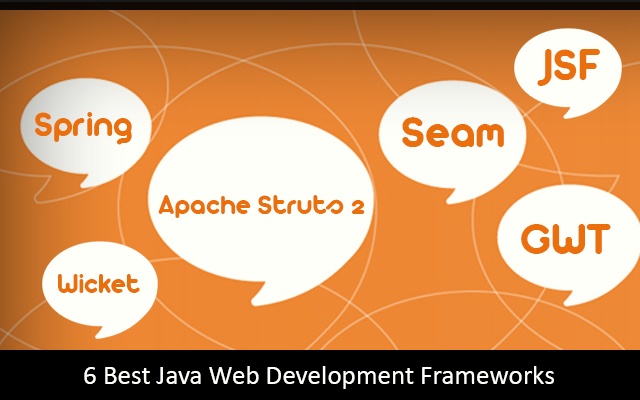
6 Best Java Web Development Frameworks

Java application supportMost developers use Java frameworks to build engaging and interactive web application without putting any extra time and effort. Also, each developer has options to choose from a variety of Java web application development frameworks to suit the specific requirements of his project. Similar to other advanced web development frameworks, most Java development frameworks now support the Model-View-Controller (MVC) design. The design makes it easier for developers to separate business logic and presentation.

Further, the flow of client requests and server actions are coordinated in a logical way through a controller. Each Java web development framework is designed with distinct features and functionality. Similarly, the Java bean wrappers, Java Server Pages and tag libraries will also differ based on your choice of framework. But a developer can still use a set of similar APIs to easily design and implement powerful web applications. If you are new to Java development, it is a good idea to check out some of these popular web development frameworks.

6 Widely Used Java Web Development Frameworks

  • Apache Struts 2: As an enterprise-ready web application development framework, Apache Struts allows developers to streamline the entire development project cycle. Struts 2 also come with an improved design with clean code for frameworks that do not depend on HTTP and create dynamic responses. A developer can use the AJAX tags to add flexibility and interactivity to the web pages by availing the advantages of standard Struts tags. He can also use Struts 2 as an open source tool to build small projects. However, the framework does not allow programmers to develop apps simply by dragging and dropping controls.

  • Spring: Spring is hugely popular as a powerful yet flexible development framework. You can use Spring to boost the look, feel and performance of your web application without writing lengthy codes. The framework allows you to integrate a wide variety of view options including PDF, Excel, Velocity and JSP/JSTL, seamlessly based on the requirements of your application. At the same time, you can also use the Inversion of Control provided by Spring to easily test your web application. The support of a large developer community also makes the framework popular for developing a variety of enterprise internet applications.

  • Wicket: In comparison to conventional Java development frameworks, Wicket is more straightforward, and also goes in the opposite direction. Without using XML, Wicket separates logic and markup, along with using a POJO data model. You can insert HTML-based templates to make the web pages dynamic, while keeping Java away from your page design. Along with offering the advantages of pure Java, the framework is also more object-oriented in comparison to others. However, a developer or designer must possess adequate experience to use Wicket in an exact and accurate way.

  • Seam: Unlike other Java development frameworks, Seam is effective in bundling Java EE standards as well as making them work together as a integrated solution. Along with core standards like EJB3 and JSF, Seam also ties other components together to facilitate smooth work flow and rule management. The integration of core standards and components has made it easier for Seam to avoid the complexity at the architecture and API level. Seam also allows enterprise application developers to avail a number of advantages like built-in libraries for PDF, graphs, Excel, and email. The reduce amount of XML will add stability to your application, whereas the built-in libraries will save your time and effort.

  • Java Server Faces (JSF): In comparison to the modern Java development frameworks, JSF is a bit older. But JSF is still popular among developers due to supporting Java EE standard. The feature makes it easier for developers to build using interfaces using components on a page. Also, the components can be used or added to make it easier for you to capture the events triggered by their actions. JSF also allows developers to avail build powerful interfaces by availing the advantaged of MVC model. Further, its stable and easy to use features can complement the needs of a variety of enterprise web applications.

  • Google Web Toolkit (GWT): The huge popularity of Google often makes developers to write AJAX applications like Gmail and Google Maps. The Google Web Toolkit makes it easier for developers to build and maintain complex front-end interfaces designed using JavaScript and Java. They can further develop and debug AJAX apps using any Java development tool of their choice. However, the use of JavaScript will require programmers to put some extra efforts to share, test and reuse the AJAX components. But some of the features provided by the framework will make it easier for them to handle bookmarking, asynchronous remote procedure calls, history management and cross-browser portability.

The choice of Java web development framework varies from one developer to another. It is always important to pick a framework by keeping in mind the specific need of your project. Also, you have to evaluate the pros and cons of individual frameworks to choose the option that saves your time and effort.

We provide Java application development services. If you would like to discuss with an expert Java developer from our team, please get in touch with us at Mindfire Solutions.